
 FR
 EN


Quality control that no longer fits in an Excel file
How Brüggen replaced a ten-year-old Excel file at its French site with an application used in production, in the laboratory and by management.
The client
Brüggen
Brüggen makes cereals, muesli and breakfast products. The group is headquartered in Lübeck, Germany, with sites in France and Poland. It mainly produces private-label goods for retailers that require IFS and BRC certification.
On each line, operators measure density, moisture or particle size at regular intervals. The laboratory checks finished products, and the quality department decides what happens to each out-of-spec lot.
The project started at the Thiers site, in the Puy-de-Dôme.
The project
Ten years of checks in a single file
All quality control relied on an Excel file with macros, built in-house and extended for more than ten years. It worked, but nobody dared touch it any more.
Only one person could open it at a time. Each audit took two days to extract the data. And losing the file would have wiped out ten years of history.
Recurring bugs and nobody to fix them.
The quality workstation became a bottleneck.
Two days of manual extraction before each audit.
Ten years of history in a single file.
What we put in place
QualiKorn, quality control on the production floor
We developed QualiKorn with the quality manager and the operators. The application follows a product's real path: the in-line measurement, the finished-product check, then the decision on held lots.
Data entry in production
The operator enters measurements on the current production order. The recipe limits appear next to each field, and an out-of-range value shows straight away.

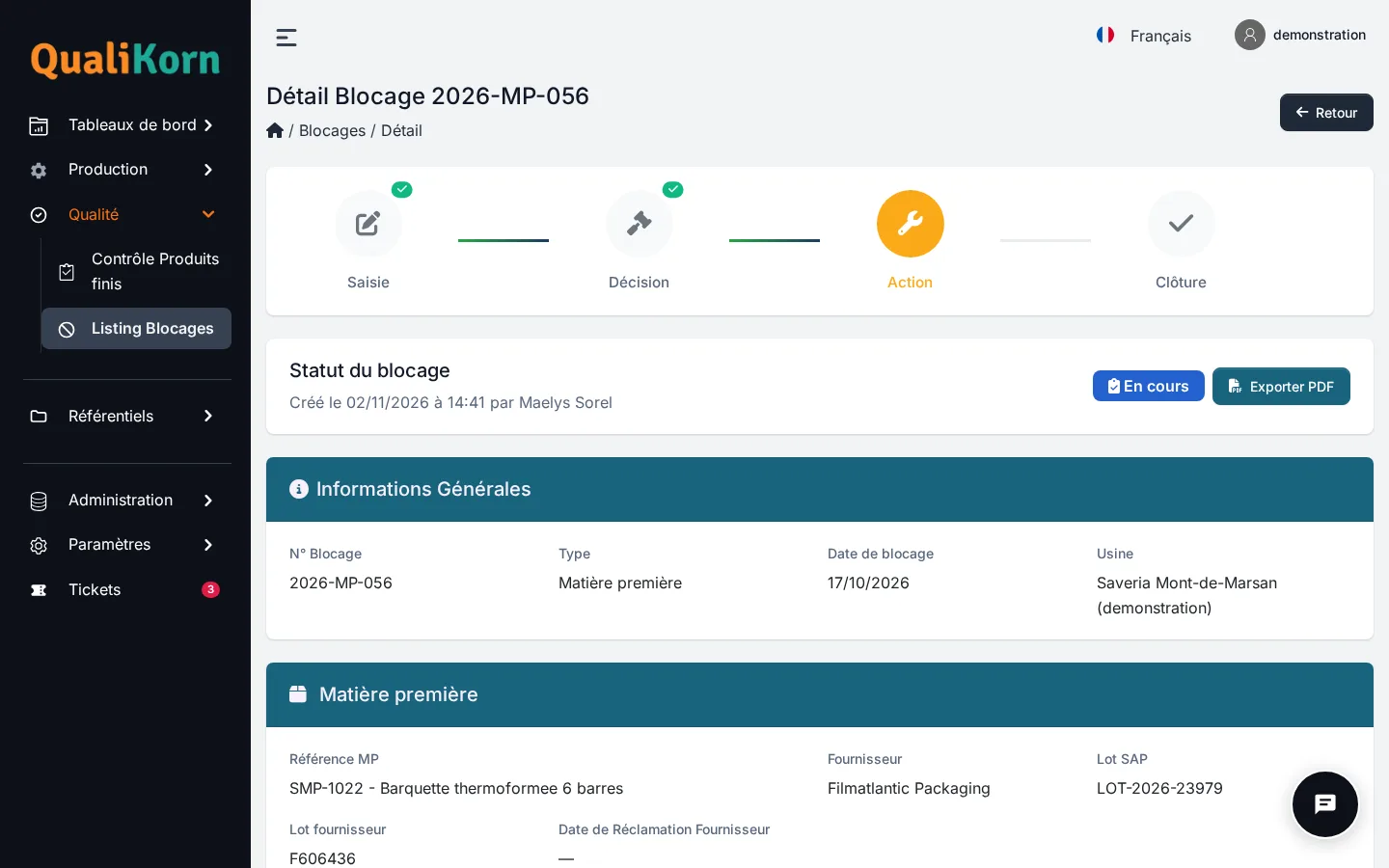
Holds, from finding to decision
An out-of-spec lot is put on hold. The record follows the entry, the decision (release, sorting, destruction, return to supplier), the corrective action and the closure, with the cost of poor quality.
Dashboards for management
Open holds, tonnage on hold, cost of poor quality, compliance by team. The figures update with each entry.
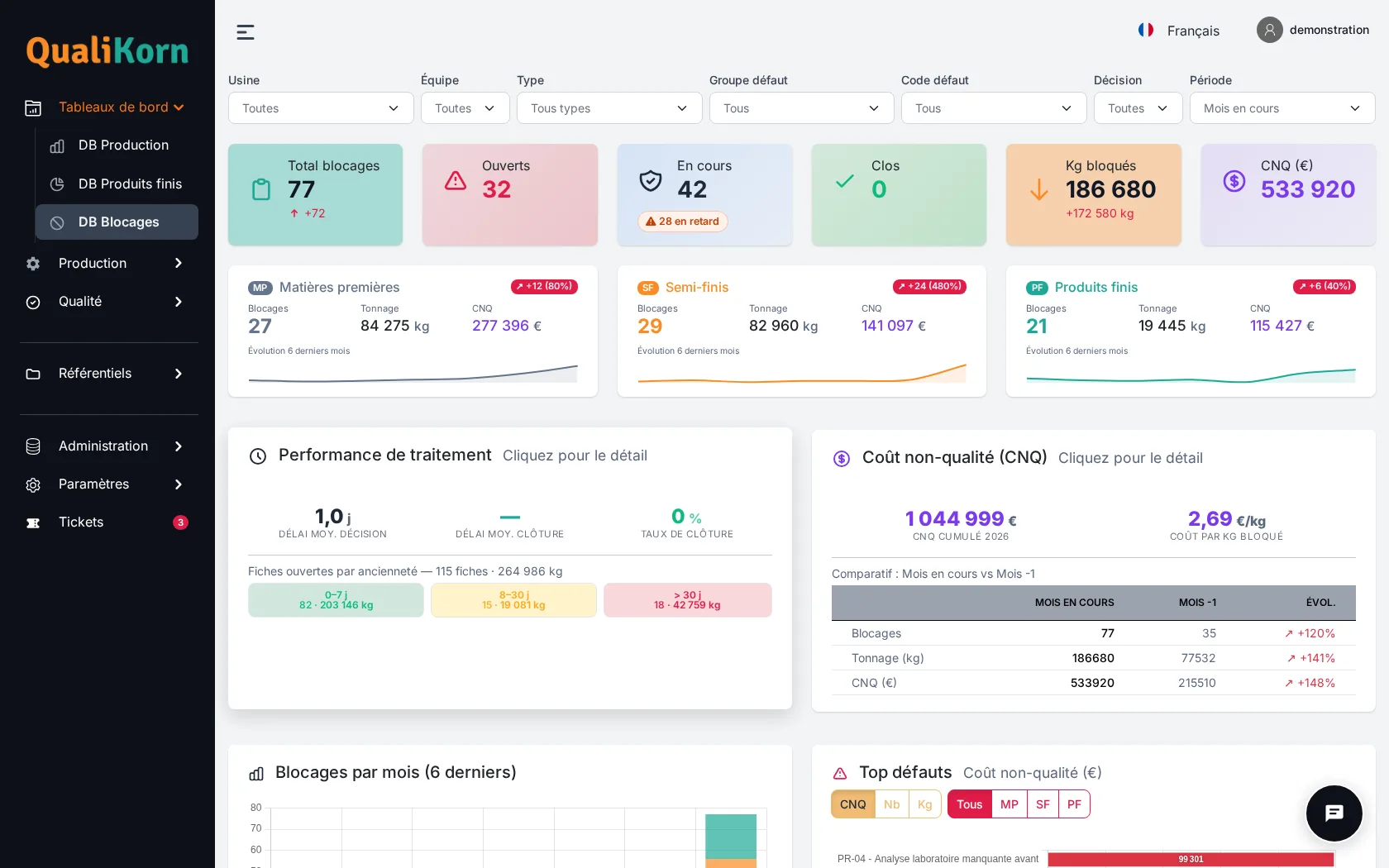
Screenshots taken on demo data.
How we got there
Migrating the history without losing anything
The trickiest part was the history. We wrote migration scripts that read the Excel file, clean the data and load it into the new database. Every record was checked before the switch-over.
Meanwhile the application was built in stages, tested by operators on their own lines. The old file stayed available read-only until acceptance testing was complete.
A web application used on tablets in production and on computers in the laboratory, available in five languages.
Timeline
Nine months from scoping to deployment
Checks, recipes and decision flows recorded on the shop floor.
Regular deliveries, tested by the operators.
Ten years of history checked, then loaded.
Team training, switch-over, then ongoing improvements.
Results
What changed for the quality team
Integrating Qualikorn into our quality control system has enabled us to improve our responsiveness, reduce tedious tasks, centralize data and, above all, analyze our results more meticulously. The software also has the ability to generate customized reports for all communications with our clients. In short, it is an intuitive tool that allows non-technical users to quickly become familiar with the interface, while enabling more experienced users to achieve an extremely advanced level of analysis.
Does your quality control still live in a spreadsheet?
A 30-minute QualiKorn demo, based on one of your check sheets.